Memory Care Costs in West Columbia: What Midlands Families Should Know
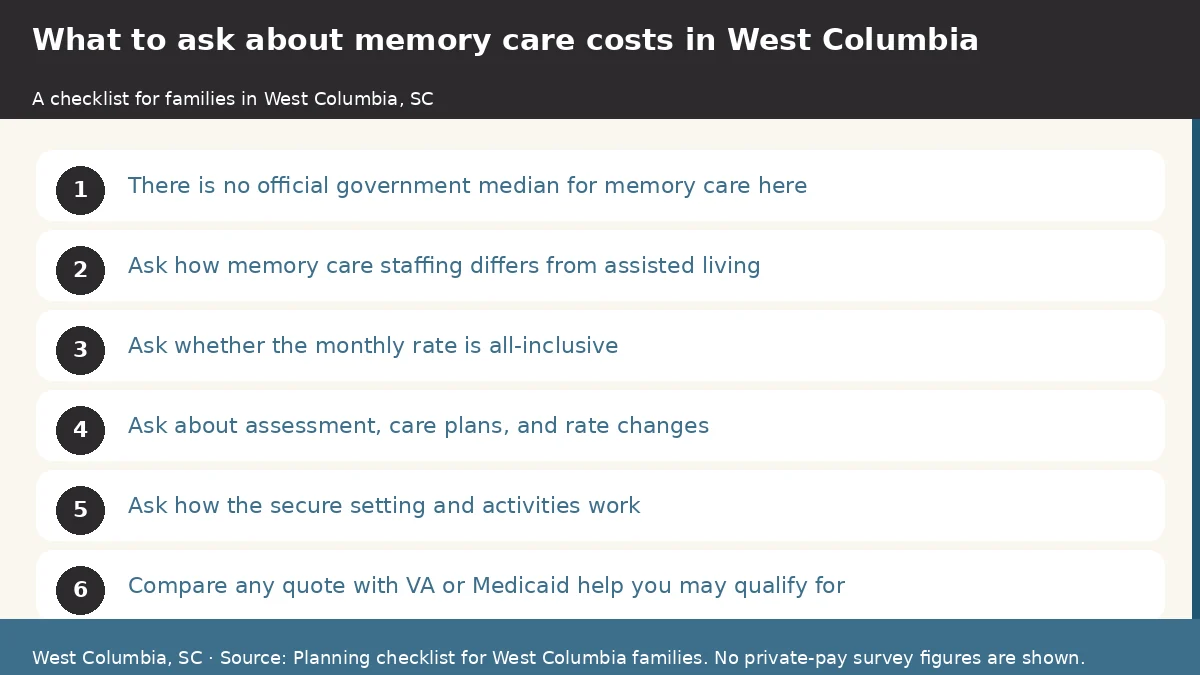
There is no official federal or South Carolina survey that publishes a private-pay median for memory care in West Columbia. Memory care is usually priced higher than standard assisted living because of staffing, training, and a more structured setting, but the only reliable figure is a written quote.
Medicare does not pay for room, board, or ongoing custodial care in assisted living if that is the only care someone needs (Medicare.gov: long-term care coverage).
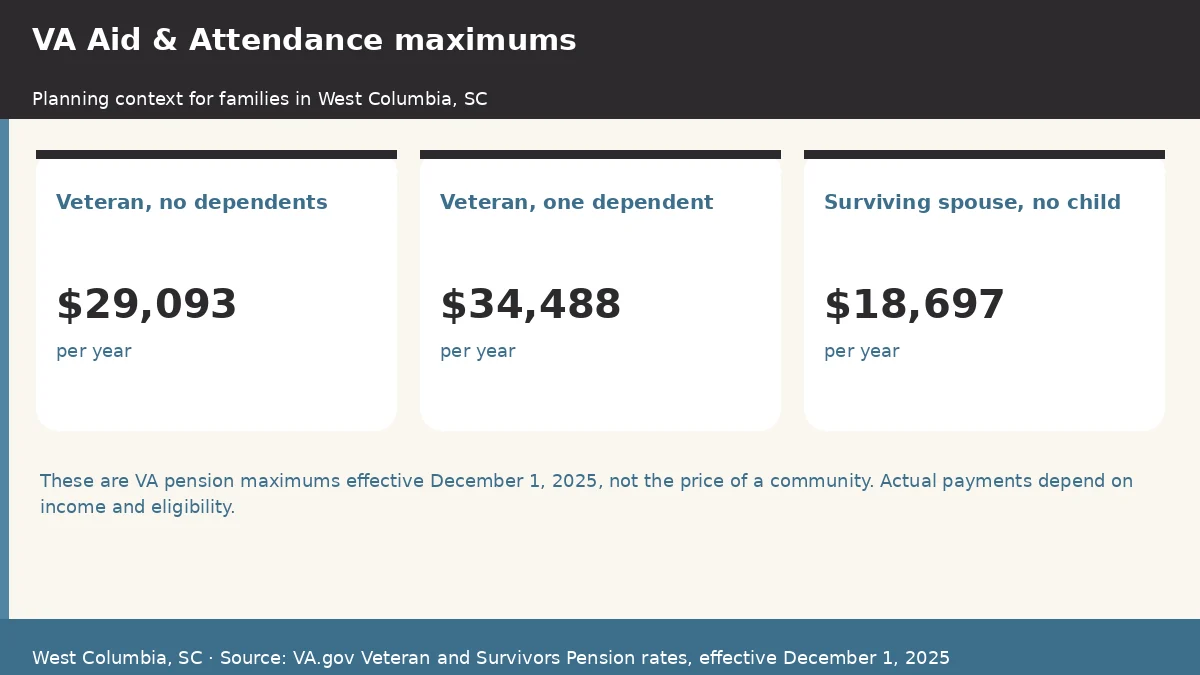
Eligible wartime Veterans and surviving spouses can review VA pension with Aid and Attendance. As of December 1, 2025, the maximum annual pension rate with Aid and Attendance is $29,093 for a Veteran with no dependents and $34,488 for a Veteran with one dependent (current VA pension rates). A surviving spouse’s Aid and Attendance maximum is $18,697 a year with no dependent children (VA Survivors Pension rates). These are benefit limits, not the price of a West Columbia community. The net worth limit for these pensions is $163,699 from December 1, 2025, through November 30, 2026.
For local public-benefit counseling, start with the federal Eldercare Locator at 1-800-677-1116, which connects families to the Area Agency on Aging that serves West Columbia, South Carolina.
When a parent is living with Alzheimer's disease or another dementia, families often reach a point where daily life at home, or even in standard assisted living, no longer feels safe. Memory care is designed for that stage, with more supervision, structured routines, and a secure environment. It is also one of the hardest costs to research, because most published surveys do not report it separately. This guide explains what the data shows for the West Columbia and Columbia area, how South Carolina regulates memory care programs, and how families can compare options.
A note before we begin: Jenni-Lynn Senior Living offers assisted living and independent living. We do not operate a dedicated secured memory care program. We wrote this guide because many families we talk with are weighing memory care, and we want them to have clear, sourced information.
Why there is no single local figure
Memory care is generally priced above that, because it involves more staff time and supervision.
That is a national figure from one type of community. It shows the general gap between the two levels of care, but it is not a West Columbia price. The only reliable way to know local memory care costs is to ask each program for a written quote.
How South Carolina regulates memory care
In South Carolina, memory care is usually offered by a licensed community residential care facility or nursing home with an Alzheimer's special care unit or program. The state's Alzheimer's Special Care Disclosure Act requires any nursing home, community residential care facility, or adult day care facility that offers an Alzheimer's special care unit or program to disclose, to the person seeking placement, what makes its care especially suitable for people with Alzheimer's disease (S.C. Code § 44-36-520).
The law lists what that disclosure must cover:
- Criteria for admission, transfer, and discharge
- Care planning
- Staffing patterns
- Staff training
- Physical environment
- Resident activities
- The family's role in care
- Unique costs associated with the specialized services
This is a powerful tool for families. Ask every memory care program for its written disclosure, and use it to compare programs side by side. The Department of Public Health lists the Disclosure Act among the laws that apply to community residential care facilities (SC Department of Public Health, Community Residential Care Facilities).
What shapes the price of memory care
Staffing and supervision
People living with dementia often need frequent check-ins, step-by-step help with daily tasks, and someone awake and available at night. More staff time means a higher price.
Programming
Memory care programs usually include structured routines and activities adapted to cognitive needs, such as music, simple tasks, sensory activities, and time outdoors in a secure space.
Environment
Secured exits, simple layouts, calm lighting, and safe outdoor areas add to the cost of operating memory care.
Pricing structure
Some programs charge one inclusive rate. Others charge a base rate plus care levels. The Disclosure Act requires programs to explain unique costs tied to specialized services, so ask for that information in writing.
Comparing memory care with other options
A nursing home provides round-the-clock nursing care, which some people with advanced dementia need. Many people living with dementia do not need that level of medical care, but do need the supervision and structure of memory care.
Where Jenni-Lynn may fit
For some people with mild memory changes, a supportive assisted living setting with medication help, reminders, and familiar routines can work well for a time. When safety, wandering, or confusion become serious concerns, a dedicated secured memory care program is usually the better choice. We are glad to talk honestly about your parent's needs and whether our assisted living is a good fit. Our guide to signs it may be time for assisted living may also help.
How families pay for memory care
Most families pay privately, using income, savings, home equity, and long-term care insurance. Other sources include:
VA Aid and Attendance. Wartime veterans and surviving spouses who meet income, asset, and care-need requirements may receive an enhanced pension. From December 1, 2025, through November 30, 2026, the maximum annual pension with Aid and Attendance is $29,093 for a veteran with no dependents and $34,488 for a veteran with one dependent, with a net worth limit of $163,699 (VA, Veterans Pension rates).
Optional State Supplementation. South Carolina's OSS program helps low-income residents of licensed and enrolled community residential care facilities. Our guide to paying for assisted living in South Carolina explains how it works.
Long-term care insurance. Many policies pay benefits when a person has a cognitive impairment.
Questions to ask memory care programs
- May I have your written Alzheimer's special care disclosure?
- Is memory care priced as one rate or as a base rate plus care levels?
- How many staff are on duty during the day, evening, and overnight?
- What dementia training do staff receive?
- How are exits secured, and is there safe outdoor space?
- What would lead to a transfer or discharge?
- How do you involve families in care planning?
Local support
The Central Midlands Area Agency on Aging, 803-376-5390, offers family caregiver support, including respite assistance, plus information and referral for families in Lexington and Richland counties (Central Midlands Area Agency on Aging).
Talk with Jenni-Lynn Senior Living
If you are unsure whether your parent needs memory care or assisted living, call (803) 674-8126. We will listen, answer honestly, and help you think through next steps, even if another setting is the right fit.
Frequently asked questions
How much does memory care cost in West Columbia, SC?
There is no published West Columbia memory care figure.
How much more does memory care cost than assisted living?
Local differences vary.
What is the Alzheimer's Special Care Disclosure Act?
A South Carolina law requiring facilities with an Alzheimer's special care unit or program to disclose admission criteria, staffing, training, environment, activities, family role, and unique costs.
Does Jenni-Lynn offer memory care?
Jenni-Lynn offers assisted living and independent living, not a dedicated secured memory care program. We are happy to discuss whether our assisted living fits your parent's needs.