Assisted Living vs. In-Home Care: Comparing Costs in West Columbia, SC
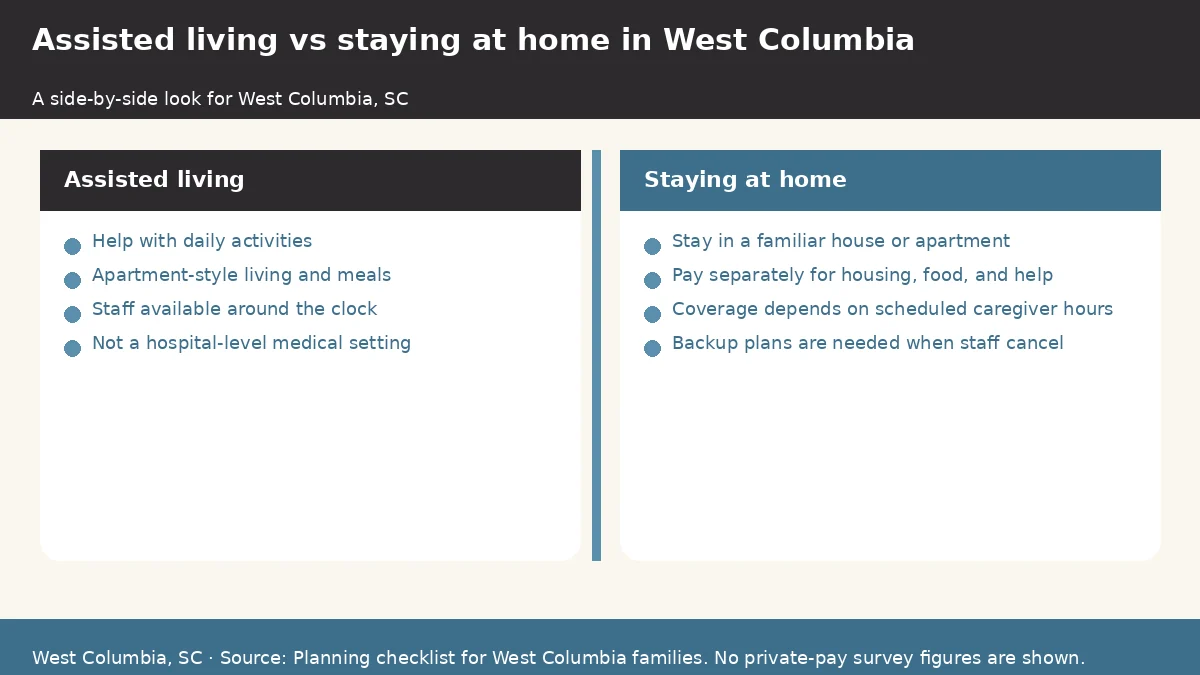
A fair comparison between assisted living and staying at home in West Columbia should include housing, food, utilities, transportation, backup coverage, and unpaid family caregiving—not only an hourly caregiver rate. Ask agencies and communities for written estimates based on the hours and help actually needed.
Medicare does not pay for room, board, or ongoing custodial care in assisted living if that is the only care someone needs (Medicare.gov: long-term care coverage).
Eligible wartime Veterans and surviving spouses can review VA pension with Aid and Attendance. As of December 1, 2025, the maximum annual pension rate with Aid and Attendance is $29,093 for a Veteran with no dependents and $34,488 for a Veteran with one dependent (current VA pension rates). A surviving spouse’s Aid and Attendance maximum is $18,697 a year with no dependent children (VA Survivors Pension rates). These are benefit limits, not the price of a West Columbia community. The net worth limit for these pensions is $163,699 from December 1, 2025, through November 30, 2026.
For local public-benefit counseling, start with the federal Eldercare Locator at 1-800-677-1116, which connects families to the Area Agency on Aging that serves West Columbia, South Carolina.
Many older adults in West Columbia and Lexington County would rather stay in their own homes, and in-home care can help them do that. As needs grow, though, families have to weigh what home care really costs against assisted living. In the Columbia area, the answer is more nuanced than in many markets: full-time home care can cost a little less than the assisted living median on paper, but that comparison leaves out housing, meals, and overnight help. This guide lays out the 2025 numbers and the trade-offs.
The 2025 numbers
But home care covers only those 44 hours of help. Assisted living includes a room, meals, housekeeping, activities, and staff available day and night.
How costs change with hours
These estimates multiply the hourly median by hours per week and about 4.33 weeks per month. Agencies may set minimum visit lengths and charge more for nights, weekends, and holidays. Once needs pass about 49 hours a week, home care costs more than the assisted living median even before housing is counted.
What each option includes
In-home care
- Help with bathing, dressing, and personal care
- Light housekeeping and meal preparation
- Companionship and reminders
- Help only during scheduled hours
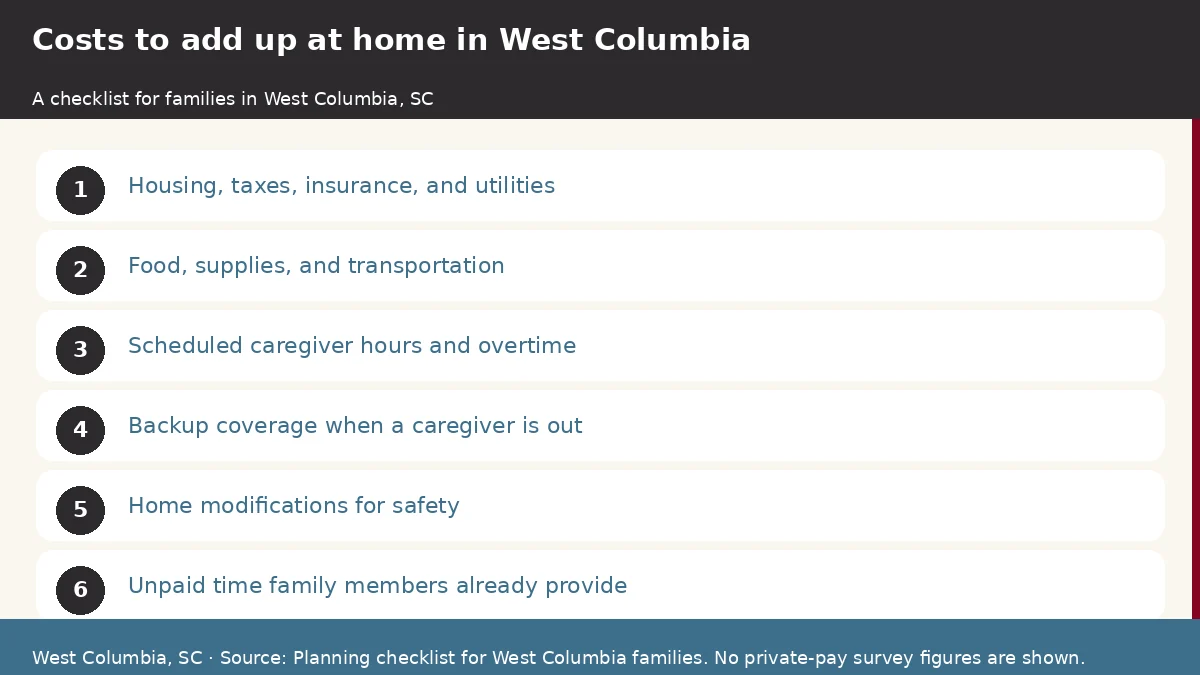
At home, your parent still pays the mortgage or rent, property taxes, homeowners insurance, utilities, summer air conditioning, groceries, yard care, and repairs.
Assisted living
In South Carolina, assisted living communities are licensed as community residential care facilities, which the Department of Public Health describes as offering room and board and providing or coordinating personal care (SC Department of Public Health, Community Residential Care Facilities). Typical services include:
- A private or semi-private room
- Three meals a day
- Help with personal care and medications
- Housekeeping and laundry
- Activities and transportation
- Staff available around the clock
A worked example
A West Columbia mother needs help each morning and evening with bathing, dressing, and medications, about four hours a day, seven days a week. If she starts to need help at night, or someone to check on her between visits, home care costs rise quickly.
When in-home care makes sense
- Your parent needs a few hours of help a day
- Your parent is safe alone the rest of the time
- Family members nearby can fill the gaps
- The home is safe and accessible, or can be adapted
- Your parent strongly prefers home and can stay there safely
When assisted living may make more sense
- Help is needed at unpredictable times, or overnight
- Your parent is lonely or isolated
- Keeping up the house and yard has become a burden
- Family caregivers are exhausted
- Home care hours are climbing toward 49 or more a week
How Medicare and Medicaid fit in
Medicare can cover part-time skilled home health care for people who are homebound and meet other conditions, but not ongoing personal care alone, and not assisted living (Medicare, home health services).
South Carolina's Community Choices waiver offers qualified people the choice to receive assistive services at home rather than in a nursing home. It serves adults 65 and older, and adults 18 to 64 with physical disabilities, who meet nursing facility level of care criteria (SCDHHS, Community Choices waiver).
For lower-income assisted living residents, Optional State Supplementation helps people living in licensed and enrolled community residential care facilities. Our guide to paying for assisted living in South Carolina explains it.
Hidden costs of staying home
- Grab bars, ramps, or a walk-in shower
- A medical alert system
- Meal delivery or extra groceries
- Rides to appointments, the pharmacy, and church
- Yard care and home repairs
- Lost income for family caregivers
The family caregiver's share
In many families, a spouse or adult child provides much of the care without pay. When comparing costs, estimate how many hours family members provide and what it would cost to replace that help if a caregiver became ill or could no longer continue.
Mixing options
Some families combine a few hours of home care with family help, an adult day program, and occasional respite stays in assisted living. Respite gives caregivers a real break and lets a parent try community living without a long-term commitment. Our guide to respite care in West Columbia explains how it works. The Central Midlands Area Agency on Aging, 803-376-5390, can assess eligibility for in-home services such as homemaker help, personal care, and home-delivered meals (Central Midlands Area Agency on Aging).
Questions for a home care agency
- What are your rates for weekdays, nights, weekends, and holidays?
- Is there a minimum visit length?
- How are aides screened, trained, and supervised?
- What happens if an aide is sick?
- Can the same aide come regularly?
Revisit the plan
Needs change. Many families start with a few hours of help at home and revisit the plan every few months or after any fall or hospital stay.
Talk with Jenni-Lynn Senior Living
Jenni-Lynn Senior Living, at 915 Hook Avenue in West Columbia, offers assisted living and independent living cottages. Call (803) 674-8126 to compare our rates with the cost of care at home.
Frequently asked questions
Is in-home care cheaper than assisted living in West Columbia?
But home care does not include housing, meals, or overnight help.
How much is home care per hour in the Columbia, SC area?
No. Medicare does not pay for room, board, or ongoing personal care in assisted living if that is the only care needed.
Does Medicare pay for home care?
Medicare can cover part-time skilled home health care for homebound people who qualify, but not ongoing personal care alone.
Does South Carolina Medicaid pay for in-home care?
The Community Choices waiver can provide services at home for qualified people who meet nursing facility level of care criteria.